View More Articles
7 min readJan 30, 2026

The Ultimate Guide for Traveling to Super Bowl LX 2026
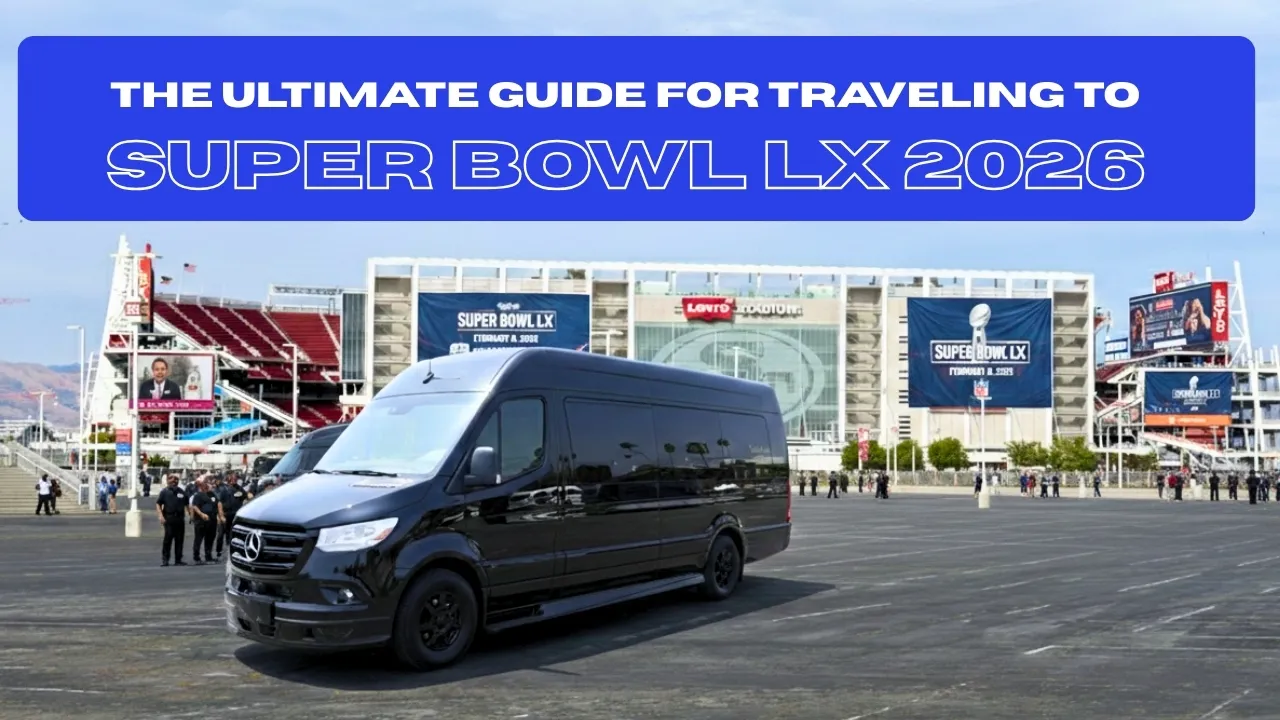
The Ultimate Guide for Traveling to Super Bowl LX 2026

Every February, America collectively agrees on one thing: plans can wait, diets can wait, and traffic absolutely cannot be ignored. In 2026, that energy lands squarely in the San Francisco Bay Area, where Super Bowl LX turns an entire region into football’s biggest stage.

On Super Bowl Sunday 2026 (February 8), the world’s eyes lock onto Levi’s Stadium in Santa Clara, but the action doesn’t stay in one seat. Levi’s Stadium events, citywide San Francisco events, concerts, fan festivals and the iconic Super Bowl halftime show 2026 will take over the Bay Area all week long. And as Archie Griffin wisely put it:

“It’s not the SIZE of the dog in the fight, but the size of the FIGHT in the dog.”

During Super Bowl Week, that “fight” is mostly about getting your group where it needs to be without losing your voice, patience or parking spot. 

Why the Super Bowl Is Basically America’s Favorite Excuse to Celebrate

The Super Bowl started back in 1967 as a championship between the NFL and AFL. Fast-forward to Super Bowl 2026, and it has evolved into the largest annual sporting event in the United States, part game, part concert, part national food festival.

Some fun reality checks: 

  • 121.1 million plan to throw or attend a Super Bowl party on game day

  • 213.1 million people plan to tune in to watch the big game this year

  • Winners lift the legendary Vince Lombardi Trophy

  • Roman numerals are used (LX = 60, still confusing, still iconic) 

Super Bowl Week = Nonstop San Francisco Events

Here’s the thing most first-timers don’t realize: Super Bowl Sunday is just the finale.

All week long, the Bay Area hosts:

  • NFL Super Bowl Experience at Moscone Center (interactive games, exhibits, player appearances). Super Bowl Experience tickets, which grant access to the NFL’s interactive fan festival, start at around $50, with average prices ranging between $75 and $125 depending on the date and demand.

  • Concerts, pop-ups and celebrity-filled parties

  • Fan festivals and branded activations across downtown

  • Packed Levi’s Stadium events before and after game day.

Translation: Your group will be moving. A lot.

Super Bowl Halftime Show 2026: When Football Takes a Concert Break

With all due honesty, for a lot of people, the most important question isn’t who’s playing in the Super Bowl, it's who is performing at the Super Bowl 2026 halftime show. The NFL hasn’t dropped the official announcement yet, but with Bad Bunny heavily rumored, expectations are already sky-high.

Additionally, headliners include Dave Chappelle, Shaquille O’Neal (DJ Diesel), Post Malone, Kehlani, Calvin Harris, Diplo, Green Day, The Chainsmokers, Luke Combs, Sting, Chris Stapleton and The Killers, along with appearances by artists like Fall Out Boy, Noah Kahan, Ludacris, T-Pain, Sean Paul, Wale and Counting Crows. From warehouse EDM shows and stadium-scale concerts to comedy, hip-hop, country and pop performances, Super Bowl week turns the Bay Area into a nonstop entertainment hub leading up to the big game.

Translation? 

  • Massive crowds 

  • Wall-to-wall watch parties.

  • And absolutely no room for “we’ll figure it out later” plans.

By the time the halftime show hits, the Bay Area will be buzzing louder than the stadium itself.

Where Is the Super Bowl 2026? And Why You Don’t Want to Figure It Out at the Last Minute

Here’s the scoop: Super Bowl 2026 lands at Levi’s Stadium in Santa Clara, about 45 miles south of San Francisco. Sounds simple… until you realize that the Bay Area is about to be flooded with tens of thousands of fans, balloons, banners and the occasional screaming mascot. 

Getting there? Let’s just say it’s more like a strategic play than a casual drive:

  • Traffic is the real MVP. Every lane suddenly feels like the 50-yard line during a tied game.

  • Road closures appear like surprise blitzes, and detours will test your patience.

  • Rideshare prices spike like a last-minute touchdown pass.

Public transit exists, and it works for some: BART + VTA, Caltrain + VTA, or dedicated fan shuttles. But for groups? Think of it as trying to herd a team of hyper fans with coolers, jerseys and snacks through a maze that is crowded, slow and slightly chaotic.

Bottom line: getting to Levi’s Stadium events or hopping between San Francisco events shouldn’t feel like a contact sport. You want style, space and zero sweating over schedules. Because when transportation is easy, the whole Super Bowl week suddenly becomes fun instead of frantic.

Why a Luxury Sprinter Van Wins Super Bowl Weekend

This is where TourVanGo's luxury Sprinter Vans become the MVP.

One vehicle. One plan. One group.

You get:

  • Comfortable seating

  • Space for bags, food and tailgate supplies

  • Climate control

  • Door-to-door service

  • Zero surge pricing surprise.

And in the words of Vince Lombardi: “Once you LEARN to quit, it becomes a HABIT.”

Quit fighting traffic. Quit juggling rides. Quit stressing.

How Groups Actually Roll in Sprinter Vans During Super Bowl Week

Think of a luxury Sprinter van as your mobile command center for Super Bowl LX: part ride, part party, part survival kit.

Hotel → Fan Zones → Parties → Repeat
Wake up at the hotel, roll into San Francisco events, pop into fan zones, concerts and pop-ups, then cruise to evening parties like a VIP. No stress, no rideshare roulette, no “where’s the parking?” panic. Just smooth moves and the whole crew together.

Tailgate Runs to Levi’s Stadium
Coolers? Check. Flags? Check. Jerseys and snacks? Absolutely. Your Sprinter van handles the gear so you arrive tailgate-ready and energy-maxed, not dragging like you ran a marathon before kickoff.

San Francisco by Day, Santa Clara by Night
See the city, hit the museums, check out the fan festivals, then roll down to Levi’s Stadium events at night. No transfers, no crowded trains, no sweating over schedules. You move like a team of pros while everyone else fights traffic.

Los Angeles → Bay Area Road Trips
Some groups go full MVP: driving from LA turns the ride into its own party. Music blaring, snacks flowing, debates over Super Bowl 2026 predictions heating up and suddenly, the trip itself is part of the fun.

Bottom line: When your ride works, everything else clicks.
Less stress. More laughs. Bigger memories. That’s how Super Bowl Week should feel.

Pro Tips for Super Bowl 2026 Group Travel

  • Book early; this week sells out fast
    Super Bowl 2026 is not a “last-minute deal” kind of event. Transportation, hotels and premium services fill up months in advance. Locking in your group ride early gives you better availability, better timing options and one less thing to stress about while everyone else is scrambling.

  • Coordinate pickups from hotels, airports or restaurants
    Your group won’t always be in one place, and that’s okay. Plan pickups from multiple hotels, airports or pre-game restaurants so no one’s left Uber-hopping or sprinting through parking lots. One coordinated plan keeps the group together and on schedule.

  • Plan multi-day rentals if you are attending multiple events
    Super Bowl Week isn’t just Sunday. Between NFL fan experiences, concerts, parties and Levi’s Stadium events, a multi-day rental gives your group total flexibility. No rebooking, no schedule juggling, just hop in and go.

  • Bring the gear; you’ll have space for it
    Jerseys, signs, coolers, tailgate food, merch bags… Super Bowl fans travel heavily. Luxury Sprinter vans offer room for people and their gear, so you don’t have to choose between comfort and bringing the fun.

Final Whistle: Travel Like a Champion 

Super Bowl Sunday 2026 is about memories, big plays, loud cheers and unforgettable moments. Getting there shouldn’t be the hardest part of the trip.

With TourVanGo luxury Sprinter van rentals, your group travels comfortably between San Francisco events, Levi’s Stadium events and everything in between.

Book your TourVanGo Sprinter van now and experience Super Bowl 2026 like champions: organized, comfortable and stress-free.

Read More Interesting Entries

TourVanGo graphic featuring USA stadiums for FIFA World Cup 2026 with a luxury Mercedes tour van and collage of major stadium venues across the United States.

The FIFA World Cup 2026 will make history as the first World Cup hosted across three nations-the United States, Canada, and Mexico. Three countries. 48 teams. And a continent-wide celebration where stadiums turn into theaters of dreams, heartbreaks, and unforgettable goals. But here’s the real headline: the United States isn’t just hosting matches - it’s hosting the spotlight.

From the bright lights of Los Angeles to the electric energy of New York, from Texas-sized stadiums to the roaring crowds of Seattle, America’s biggest cities are gearing up to become global football capitals overnight. So whether you're a die-hard fan planning a cross-country football road trip or just someone who wants to say “I was there,” this guide breaks down every major U.S. stadium hosting World Cup 2026 matches, where they are, how to get there, and what games to expect.

Mercedes-Benz Stadium - Atlanta, Georgia

Capacity: 75,000

About the Venue

Mercedes-Benz Stadium doesn’t really feel like a normal stadium when you first see it. The place looks more like something pulled from a sci-fi movie than a football venue. The retractable roof opens in this dramatic pinwheel shape, and the giant halo video board wrapping around the roof makes even regular-season games feel huge.

By the time the FIFA World Cup 2026 arrives, Atlanta is probably going to feel like one giant fan festival. The stadium has already hosted Super Bowls, international soccer matches, and massive concerts, so it’s built for events that attract global attention. And honestly, that matters during a World Cup. Fans want more than seats and screens. They want an atmosphere, noise, energy. This place delivers all of it.

Getting There

Atlanta is one of the easiest cities to fly into during the tournament.

  • Closest airport: Hartsfield–Jackson Atlanta International Airport (ATL)
  • Around 15–20 minutes from downtown without heavy traffic
  • MARTA rail makes getting to the stadium surprisingly manageable
  • Plenty of hotels nearby in Downtown and Midtown Atlanta

For international fans planning long trips across multiple cities, Atlanta works well as a travel hub. Flights are constant, and transportation feels more straightforward compared to some larger host cities.

Key Matches

Mercedes-Benz Stadium will host:

  • Group-stage matches
  • Knockout-stage games
  • The World Cup semifinal on July 15, 2026

Gillette Stadium - Foxborough, Massachusetts

Capacity: 65,000

About the Venue

Gillette Stadium sits between Boston and Providence, and while it’s best known for football, the World Cup atmosphere here could end up being one of the
loudest in the country.

New England fans take sports personally. They’re emotional, loyal, occasionally chaotic in the best possible way. That kind of crowd creates incredible tournament energy, especially during knockout games. The stadium itself feels less flashy than some of the newer venues, but that may actually work in its favor. There’s a
classic big-event feeling around the place that suits international football.

Getting There

  • Closest airport: Logan International Airport (BOS)
  • Usually 45–60 minutes from Boston depending on traffic
  • Commuter rail service is expected during major matches
  • Most visitors will likely stay in Boston and travel to Foxborough on match day

Boston also gives fans a chance to mix football with history, seafood spots, and that unmistakable East Coast summer atmosphere.

Key Matches

Gillette Stadium will host:

  • Group-stage fixtures
  • The quarterfinal on July 9, 2026

AT&T Stadium - Arlington, Texas

Capacity: 92,000

About the Venue

Everything in Texas feels oversized, and AT&T Stadium is probably the perfect example of that. The place is enormous. Massive screens, massive crowds, massive everything. When World Cup matches land here, Arlington could easily become one of the busiest football destinations anywhere in North America. The stadium was designed for spectacle, and during FIFA 2026, that giant retractable-roof venue is going to be packed with fans from every corner of the world.

It’s also one of the strongest candidates for an unforgettable atmosphere during the knockout rounds simply because of the scale.

Getting There

  • Closest airports: Dallas/Fort Worth International Airport (DFW) and Dallas Love Field (DAL)
  • Huge highway network across the Dallas–Fort Worth metroplex
  • Hotel options spread across Arlington, Dallas, and Fort Worth

One thing travelers should know early: distances in Texas are bigger than they look on a map. Planning transportation ahead of time matters here.

Key Matches

AT&T Stadium will host:

  • Group-stage matches
  • Knockout-stage fixtures
  • The World Cup semifinal on July 14, 2026

NRG Stadium - Houston, Texas

Capacity: 72,000

About the Venue

NRG Stadium may quietly become one of the best World Cup cities in the U.S. Houston’s soccer culture runs deep. Walk through the city and you’ll hear conversations about teams from Mexico, Argentina, Brazil, England, you name it. During the tournament, that multicultural energy is going to spill directly into the stadium atmosphere. The retractable roof also matters more than people realize. Houston summers are intense, so climate-controlled matches could make this one of the more comfortable venues for fans.

Getting There

  • Closest airports: George Bush Intercontinental (IAH) and William P. Hobby (HOU)
  • Hobby Airport is generally easier for downtown access
  • Metro connections and rideshares are widely available

Traffic can still get rough around match days, though. Very rough.

Key Matches

NRG Stadium will host:

  • Group-stage games
  • Knockout-stage fixtures

Arrowhead Stadium - Kansas City, Missouri

Capacity: 76,000

About the Venue

Arrowhead Stadium has a reputation for being painfully loud. Opposing teams talk about it constantly. And honestly? That intensity could make Kansas City one of the sleeper hits of the entire tournament. Over the past few years, the city has invested heavily in soccer culture and infrastructure. Fans here genuinely care about the sport, which changes the feeling inside the stadium completely.

Getting There

  • Closest airport: Kansas City International Airport (MCI)
  • About 25–35 minutes from the stadium
  • Easy highway access for rental cars and rideshares
  • Most hotels are centered downtown

Kansas City is also easier to navigate than larger host cities, which some travelers may appreciate after bouncing between packed airports and giant metro areas.

Key Matches

Arrowhead Stadium will host:

  • Group-stage matches
  • The quarterfinal on July 11, 2026

SoFi Stadium - Inglewood, California

Capacity: 70,000

About the Venue

SoFi Stadium feels less like a stadium and more like an entertainment universe. The architecture is unreal. The screens are gigantic. Even the entrances feel cinematic. During the FIFA World Cup 2026, this will easily become one of the most photographed venues in the tournament.

And because it’s Los Angeles, the crowd will probably include everyone from hardcore football fans to celebrities to tourists who just want to say they witnessed the World Cup in California.

Getting There

  • Closest airport: Los Angeles International Airport (LAX)
  • Roughly 15–25 minutes away… unless LA traffic decides otherwise
  • Match-day congestion will be intense
  • Hotels near Santa Monica, Downtown LA, and Beverly Hills will fill up fast

A lot of visitors are already searching things like "How far is SoFi from LAX” or “World cup Los Angeles games” because transportation planning here is going to matter.

Key Matches

SoFi Stadium will host:

  • The United States opening match
  • Group-stage games
  • Knockout-stage matches
  • The quarterfinal on July 10, 2026

Hard Rock Stadium - Miami Gardens, Florida

Capacity: 65,000

About the Venue

Hard Rock Stadium might deliver the most international atmosphere in the United States. Miami already feels global before the World Cup even starts. Add football fans from South America, Europe, and the Caribbean, and the energy here could be unbelievable. Warm weather. Palm trees. Outdoor watch parties. Late-night
celebrations. Miami was practically built for events like this.

Getting There

  • Closest airports: Miami International Airport (MIA) and Fort Lauderdale-Hollywood International Airport (FLL)
  • Traffic around Miami Gardens can get extremely heavy
  • Brightline rail and rideshares will help many visitors move between cities

Key Matches

Hard Rock Stadium will host:

  • Group-stage matches
  • Knockout rounds
  • The quarterfinal on July 11, 2026
  • The tournament’s third-place match

MetLife Stadium - East Rutherford, New Jersey

Capacity: 82,500

About the Venue

MetLife Stadium got the biggest prize of all: the FIFA World Cup 2026 Final. And honestly, it makes sense. The stadium sits right next to New York City, one of the most recognizable places on Earth. FIFA clearly wanted a venue with global visibility, massive infrastructure, and enough hotel capacity to handle an international wave of supporters and media.

Getting There

  • Closest airports: JFK, Newark Liberty (EWR), and LaGuardia (LGA)
  • Rail and bus access from Manhattan
  • Huge hotel selection throughout New York and New Jersey

Fans staying in Manhattan will probably rely heavily on public transportation because driving around match week could become chaotic.

Key Matches

MetLife Stadium will host:

  • Group-stage matches
  • Knockout-stage fixtures
  • The FIFA World Cup 2026 Final on July 19, 2026

Lincoln Financial Field - Philadelphia, Pennsylvania

Capacity: 69,000

About the Venue

Lincoln Financial Field sits in one of the most passionate sports cities in America. Philadelphia fans are loud, emotional, and extremely invested in big sporting moments. That creates a strong World Cup atmosphere almost automatically. The stadium district is also surprisingly walkable compared to many other U.S. venues.

Getting There

  • Closest airport: Philadelphia International Airport (PHL) 
  • About 20–30 minutes to the stadium area
  • Strong regional train access from nearby East Coast cities

Key Matches

Lincoln Financial Field will host:

  • Group-stage matches
  • Knockout-stage fixtures

Levi’s Stadium - Santa Clara, California

Capacity: 68,500

About the Venue

Levi's Stadium combines Silicon Valley technology with a very California-style fan experience.The stadium is modern, clean, and heavily focused on sustainability. During the tournament, it’ll attract fans who want to mix football with Bay Area tourism, tech culture, and nearby California travel.

Getting There

  • Closest airports: San Jose (SJC), San Francisco (SFO), Oakland (OAK)
  • VTA light rail connects directly to the stadium
  • Fans staying in San Francisco should expect longer travel times on match days

Searches related to “van rental San Francisco” and “sprinter van rental San Francisco” will probably spike during the tournament as groups plan regional travel.

Key Matches

Levi’s Stadium will host:

  • Group-stage matches
  • Knockout-stage games

Lumen Field - Seattle, Washington

Capacity: 69,000

About the Venue

Lumen Field has one of the best soccer atmospheres anywhere in North America. Seattle fans are relentless. Loud from kickoff to final whistle. A lot of international visitors may not expect Seattle to be such a serious football city, but once matches begin, they’ll figure it out pretty quickly.

Getting There

  • Closest airport: Seattle -Tacoma International Airport (SEA)
  • Link light rail runs directly into downtown
  • Public transportation here is much better than in many U.S. host cities

Key Matches

Lumen Field will host:

  • Group-stage fixtures
  • The Round of 16 on July 6, 2026

Where Will the FIFA World Cup 2026 Semifinals and Final Be Played?

The two U.S. semifinals are scheduled for:

Meanwhile, MetLife Stadium will host the final on July 19, 2026. FIFA’s choices weren’t random. These venues combine massive seating capacity, strong transportation networks, climate-controlled environments, media infrastructure, and cities capable of handling enormous international crowds. Basically, they’re built for the biggest sporting event on the planet.

The United States won’t just be part of the FIFA World Cup 2026. It’s going to be the center of it. Every stadium brings something completely different to the tournament. Los Angeles delivers spectacle. Seattle brings noise. Miami adds that nonstop international energy. New York gives the World Cup its biggest stage.

And because matches are spread all across the country, transportation planning is going to matter almost as much as match tickets themselves. That’s where TourVanGo can make the trip a whole lot easier. Whether you’re traveling with family, a group of friends, or organizing full World Cup travel across multiple cities, private van and sprinter rentals can take a lot of stress out of the experience, especially in busy host cities like Los Angeles and San Francisco. For World Cup transportation, group travel, and van rental services during FIFA 2026, call (818) 566-0005. One thing’s already clear: the 2026 World Cup in the USA won’t feel like one event in one city. It’ll feel like football taking over America for an entire summer.

Read more...May 14, 2026
A cover photo depicting Sofi and Levi's Stadiums with a World Cup and descriptive text in the middle

If you’re heading to California for the FIFA World Cup 2026, you’re signing up for world-class soccer, iconic cities, and one slightly less glamorous reality transportation that requires actual strategy. The United States is hosting the biggest sporting event on the planet, and California is one of its main stages. But unlike compact European host cities where you can walk from your hotel to the stadium, California plays by different rules. Everything is bigger, farther apart, and during major events much slower to navigate. Matches are split between Los Angeles and the San Francisco Bay Area, two regions that are not only geographically distant but also operate with completely different traffic patterns and transit systems. That’s what makes transportation one of the most important parts of your World Cup planning. Let’s make sure it doesn’t become the most stressful one.

FIFA World Cup 2026 California Host Cities and Stadium Locations

California will host World Cup matches across two main venues: SoFi Stadium in Inglewood and Levi’s Stadium in Santa Clara. Internationally, they may be labeled as Los Angeles Stadium and San Francisco Stadium, but that shorthand can be a bit misleading if you’re expecting a downtown, walk-everywhere setup.

SoFi Stadium is located in the Los Angeles metro area near major freeways and close to LAX, which makes airport access relatively convenient but it’s still outside the city’s main tourist zones like Hollywood or Santa Monica.

Levi’s Stadium, on the other hand, sits in Silicon Valley, well outside downtown San Francisco, surrounded more by tech campuses than tourist streets or nightlife districts. What this really means is that location matters more than ever. You’re not just choosing where to stay, you’re deciding how much time you’re willing to spend on the road, how early you’ll need to leave before kickoff, and how smooth (or slow) your trip back will be after the final whistle.

Travel Distances and Realistic Drive Times During the World Cup

On paper, distances around both cities don’t look intimidating. In reality, World Cup traffic will rewrite the rules. The drive from Los Angeles International Airport to SoFi Stadium might look like a quick 10 to 15 minutes under perfect conditions, while downtown Los Angeles sits about 20 to 30 minutes away. In the Bay Area, the route from San Francisco to Levi’s Stadium is usually under an hour, and San Francisco International Airport to Santa Clara can be even shorter. But those are best-case scenarios basically, the version of California that exists at 3 a.m. on a Tuesday. During the World Cup, you should expect travel times to double or even exceed that. Traffic will start building hours before kickoff, particularly for high-profile matches, and it won’t magically disappear after the final whistle. Post-match congestion can stretch well into the night, especially when tens of thousands of fans leave at the same time. In other words, if your map says 30 minutes, plan for at least an hour, and give yourself extra room beyond that.

Choosing a Hotel During the FIFA World Cup Matches

Finding a place to stay during the World Cup isn’t just about availability, it’s about positioning. Hotels closest to the stadiums will be booked well in advance, and even when you secure one, it doesn’t automatically mean your travel will be simple. Both stadiums sit outside traditional city centers, which means getting there requires planning no matter where you stay. If you’re attending matches at SoFi Stadium, areas like Inglewood, El Segundo, and the LAX corridor are the most practical. Properties such as Hilton Los Angeles Airport, Hyatt Regency LAX, and nearby Inglewood hotels offer proximity, though not necessarily easy access without pre-arranged transportation. Some hotels may offer shuttle services, but these tend to be limited and fill quickly.

For Levi’s Stadium, Santa Clara is your best bet if you want to minimize travel time. Hotels like Hyatt Regency Santa Clara or Santa Clara Marriott are among the closest, with a handful of options within walking distance. The catch is availability, those rooms are among the first to disappear. The key takeaway is simple: don’t choose a hotel based solely on how it looks online. Choose it based on how easily you can get to the stadium and back.

Los Angeles Matches: SoFi Stadium

Location: 1001 S. Stadium Dr., Inglewood, CA

SoFi Stadium will be one of the headline venues of the tournament, hosting a mix of group-stage matches and knockout rounds, including multiple games involving the U.S. national team. The confirmed schedule includes matchups like USA vs. Paraguay on June 12, IR Iran vs. New Zealand on June 15, and Türkiye vs. USA on June 25, along with several high-stakes elimination games leading up to a quarterfinal on July 10.This lineup alone guarantees one thing: pressure.

Every major match will bring massive crowds, and games featuring the U.S. or knockout rounds will push transportation systems to their limits. That pressure builds hours before kickoff and lingers long after the match ends.

Parking at SoFi Stadium During the 2026 FIFA World Cup

Driving to SoFi Stadium might seem convenient, but during the World Cup, it’s far from simple. Parking will be entirely pre-reserved, with no availability for last-minute arrivals. On top of that, expanded security zones and controlled access points will slow entry significantly. Even getting close to the stadium will take time due to congestion on major routes like the I-405. Leaving is its own challenge. When tens of thousands of vehicles attempt to exit simultaneously, delays are inevitable, and gridlock becomes part of the experience. For most visitors, driving shouldn’t be the default option. Transportation will revolve around organized systems, shuttles, designated rideshare areas, and coordinated group travel.

San Francisco Matches: Levi’s Stadium

Location: 4900 Marie P. DeBartolo Way, Santa Clara, CA

Levi’s Stadium will host a full schedule of group-stage matches along with a Round of 32 fixture, bringing consistent crowds to Santa Clara throughout the tournament. The match calendar includes games like Qatar vs. Switzerland on June 13 and Paraguay vs. Australia on June 25, followed by a knockout match on July 1. Unlike Los Angeles, where traffic spreads across a wide network, congestion in the Bay Area is more concentrated. A handful of major routes handle most of the flow, which means bottlenecks can form quickly and intensify fast.

Parking at Levi’s Stadium During the 2026 FIFA World Cup

Access to Levi’s Stadium primarily runs through US-101 and surrounding arterial roads, which are already busy under normal conditions. During the World Cup, these routes will experience heavy congestion, especially in the hours leading up to each match. Parking will be reserved in advance, with demand expected to exceed supply. Security screening and controlled entry points will further slow arrival times, while post-match departures will funnel into a limited number of exits. The result is predictable: delays going in, delays coming out, and very little flexibility for last-minute decisions.

Transportation Options for FIFA World Cup 2026 in California

Getting to the stadium on match day won’t come down to a single perfect option, it will depend on how much planning you’ve done ahead of time. Public transportation will play a role, particularly in the Bay Area, but it often requires multiple connections and comes with capacity limits. Rideshare services will operate through designated pickup zones, but availability and wait times will fluctuate, especially after matches when demand spikes.

Driving introduces its own complications, from limited parking to heavy congestion, while shuttle systems and park-and-ride options offer structure but operate within fixed schedules and limited capacity. That’s why timing becomes just as important as the method you choose. Traffic doesn’t start at kickoff, it builds hours before and lingers well after. Waiting until the last minute to decide how you’ll get there is one of the easiest ways to run into delays.

When to Arrive for World Cup Matches in California

A good rule of thumb is to arrive at least three to four hours before kickoff. That window gives you time to deal with traffic, navigate security checkpoints, and enter the stadium without rushing. Arriving later increases the risk of delays and potentially missing the start of the match. Leaving early isn’t a bad idea either, but if you stay until the final whistle, expect a slower exit. With thousands of fans leaving at once, even well-organized transportation systems will take time to clear.

Closest Airports to FIFA 2026 California Stadiums

Choosing the right airport isn’t just about flights, it's about what happens after you land. For Los Angeles, LAX is the closest major airport to SoFi Stadium and the primary international gateway. It offers the most direct access but also comes with the highest exposure to congestion, especially around Inglewood and the surrounding freeway network. Alternatives like Hollywood Burbank Airport and Long Beach Airport can offer smoother arrivals, though they require longer ground transfers.

In the Bay Area, San Francisco International Airport serves as the main entry point for international travelers, even though it’s not the closest to Levi’s Stadium. That distinction belongs to San Jose Mineta International Airport, which typically offers the fastest route to Santa Clara but has limited international service. Oakland International Airport sits somewhere in between, providing flexibility but requiring careful route planning. Each airport comes with trade-offs. The best choice depends on whether you prioritize flight availability, transfer time, or overall convenience.

TourVanGo Van Rental for FIFA 2026 Transportation in California

For travelers looking to simplify everything, TourVanGo offers a more structured approach to World Cup transportation. Instead of coordinating multiple rides or navigating unfamiliar transit systems, the service focuses on planned, reliable movement between airports, hotels, and stadiums. It’s designed specifically for high-demand events, where timing and coordination make all the difference.

Van Rental Options for Small and Large Groups

TourVanGo provides vehicles suited for both smaller groups and larger parties, typically accommodating anywhere from 8 to 18 passengers. This setup works well for families, fan groups, or organized tours, allowing everyone to travel together rather than splitting into multiple cars.

Airport Transfers and Stadium Shuttle Coordination From arrival to match day, transportation is handled as a continuous plan rather than separate trips. Airport pickups, hotel transfers, and stadium drop-offs are coordinated in advance, reducing uncertainty and helping avoid delays tied to traffic or availability. That level of planning becomes especially valuable during peak match days, when flexibility disappears and demand peaks.

Why Group Transportation Is the Best Option for FIFA World Cup 2026

Events on the scale of the World Cup naturally create friction in transportation systems. Roads fill up, parking disappears, and wait times stretch longer than expected. Group transportation helps cut through that complexity. It keeps everyone on the same schedule, reduces the number of vehicles on the road, and provides a more predictable way to move between locations. In a setting where timing matters and access is limited, that kind of reliability can make a noticeable difference in your overall experience.

Final Word

The FIFA World Cup 2026 in California promises incredible matches across two iconic regions but getting around won’t be effortless. Distances between locations, heavy congestion, limited parking, and strict stadium access all add layers of complexity to what might seem like a simple trip.

That’s why planning ahead isn’t optional, it's essential. From choosing the right airport to securing transportation in advance, every decision plays a role in how smoothly your trip unfolds. And for many visitors, structured solutions like TourVanGo provide a practical way to stay organized and avoid unnecessary stress. Because when the World Cup finally kicks off, the only thing you should be worrying about… is the score.

Read more...May 5, 2026